
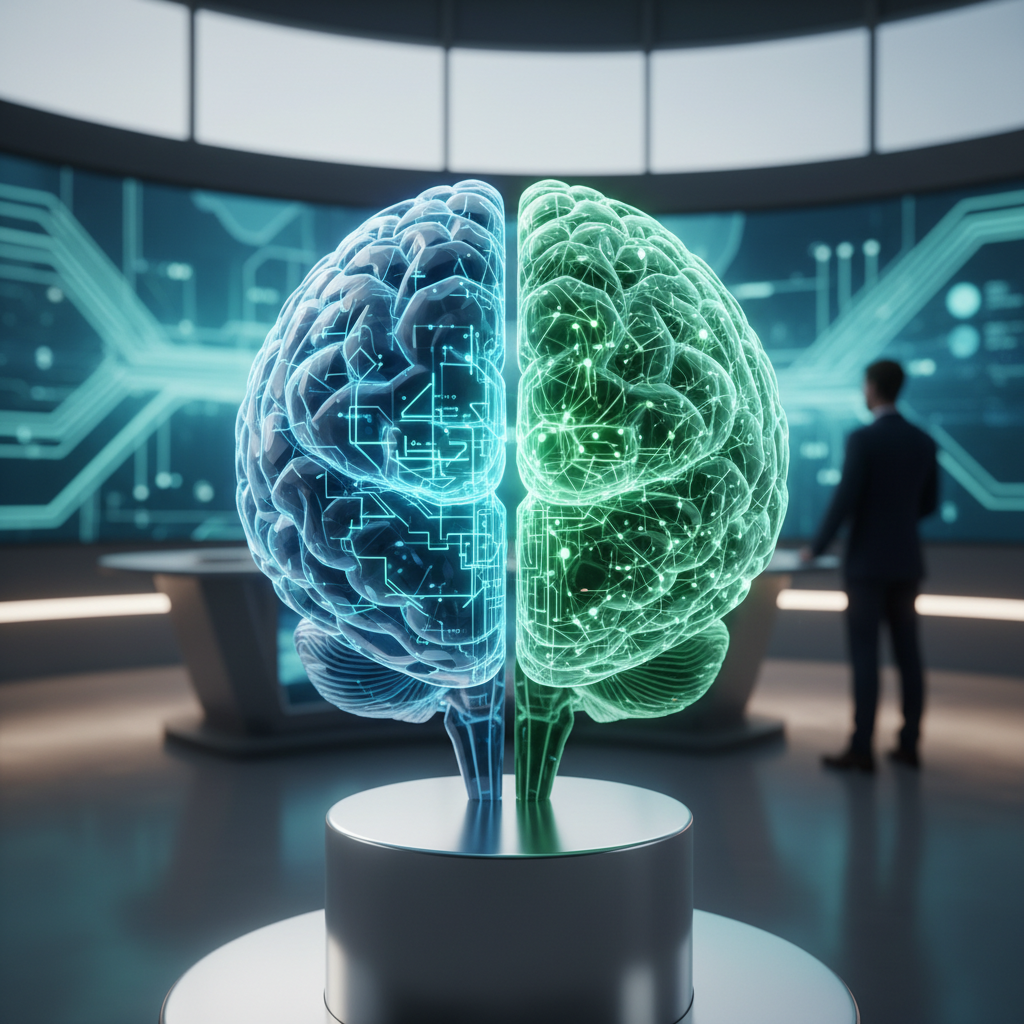
Introduction to a New Era of AI Reasoning
In a stunning development for the artificial intelligence community, a team of researchers from the Global AI Research Institute (GARI) unveiled a groundbreaking hybrid AI model on March 12, 2026. This innovative system, dubbed 'SymNeuroNet,' integrates symbolic reasoning with neural network architectures, promising to revolutionize how machines understand and solve complex problems. As AI continues to evolve, this advancement could redefine the boundaries of machine learning and logical deduction, opening new doors for applications in diverse fields like healthcare, finance, and education.
What is SymNeuroNet, and Why Does It Matter?
SymNeuroNet represents a fusion of two historically distinct approaches to artificial intelligence: symbolic AI, which relies on explicit rules and logic, and neural networks, which excel at pattern recognition through data-driven learning. For decades, these methodologies have operated in silos, with symbolic AI dominating early expert systems and neural networks powering modern deep learning breakthroughs. However, each approach has limitations—symbolic AI struggles with scalability and adaptability, while neural networks often lack transparency and struggle with abstract reasoning.
By combining these paradigms, SymNeuroNet achieves what neither could alone: a system capable of learning from data while applying logical rules to reason through novel scenarios. According to Dr. Elena Martinez, lead researcher at GARI, 'This hybrid model bridges the gap between learning and reasoning, enabling AI to tackle problems that require both empirical knowledge and deductive logic. It’s a game-changer for the field.'
How SymNeuroNet Works
The architecture of SymNeuroNet is a sophisticated blend of components:
- Neural Core: A deep learning framework that processes vast datasets, identifying patterns and correlations much like traditional neural networks.
- Symbolic Engine: A rule-based module that encodes logical structures and applies deductive reasoning to interpret the neural core’s outputs.
- Integration Layer: A dynamic interface that allows seamless communication between the neural and symbolic components, ensuring that data-driven insights inform logical decisions and vice versa.
This structure enables SymNeuroNet to excel in tasks requiring both contextual understanding and structured problem-solving. For instance, in a medical diagnosis scenario, the neural core might analyze patient data to identify potential conditions, while the symbolic engine cross-references these findings against established medical guidelines to recommend treatments with explainable reasoning.
Potential Applications of This AI Breakthrough
The implications of SymNeuroNet are vast, with potential applications spanning multiple industries:
- Healthcare: Beyond diagnostics, the model could assist in drug discovery by predicting molecular interactions (neural) and validating hypotheses through biochemical rules (symbolic).
- Finance: SymNeuroNet could enhance fraud detection by learning transaction patterns and applying logical checks to flag suspicious activities with greater accuracy.
- Education: Personalized learning platforms powered by this hybrid model could adapt to student needs through data analysis while providing structured feedback based on pedagogical principles.
- Legal Systems: The model could streamline case analysis by interpreting legal texts (symbolic) and predicting outcomes based on historical data (neural).
These use cases highlight SymNeuroNet’s versatility, positioning it as a cornerstone for future AI innovations.
Challenges and Future Directions
Despite its promise, SymNeuroNet is not without challenges. Integrating symbolic and neural systems requires significant computational resources, and fine-tuning the balance between the two components remains an ongoing task. Additionally, ensuring the model’s decisions remain interpretable—a key advantage of symbolic AI—poses a hurdle as the neural core’s complexity increases.
Looking ahead, the GARI team plans to focus on optimizing SymNeuroNet for real-world deployment. 'Our next steps involve reducing computational overhead and developing tools to make the model’s reasoning process even more transparent,' Dr. Martinez noted. Collaborations with industry leaders are also in the pipeline to test the system in practical settings, potentially accelerating its adoption.
Why This Matters for the AI Industry
The unveiling of SymNeuroNet comes at a pivotal moment for artificial intelligence. As the industry grapples with demands for more robust, explainable, and adaptable systems, hybrid models like this one offer a compelling solution. Unlike purely neural approaches, which often function as 'black boxes,' SymNeuroNet prioritizes clarity in decision-making—an essential feature for high-stakes applications like medicine and law.
Moreover, this development signals a broader shift toward interdisciplinary AI research. By revisiting symbolic methods alongside cutting-edge neural techniques, researchers are rediscovering the value of diverse perspectives in solving AI’s toughest challenges. As SymNeuroNet matures, it could inspire a new wave of hybrid systems, each pushing the boundaries of what machines can achieve.
Conclusion: A Step Toward Smarter AI
The introduction of SymNeuroNet on March 12, 2026, marks a significant milestone in the journey toward smarter, more capable artificial intelligence. By marrying the strengths of symbolic reasoning and neural networks, this hybrid model offers a glimpse into a future where machines not only learn from data but also think through problems with human-like logic. While hurdles remain, the potential of SymNeuroNet to transform industries and enhance AI’s role in society is undeniable. Stay tuned as this technology evolves—2026 may well be remembered as the year AI reasoning took a quantum leap forward.