
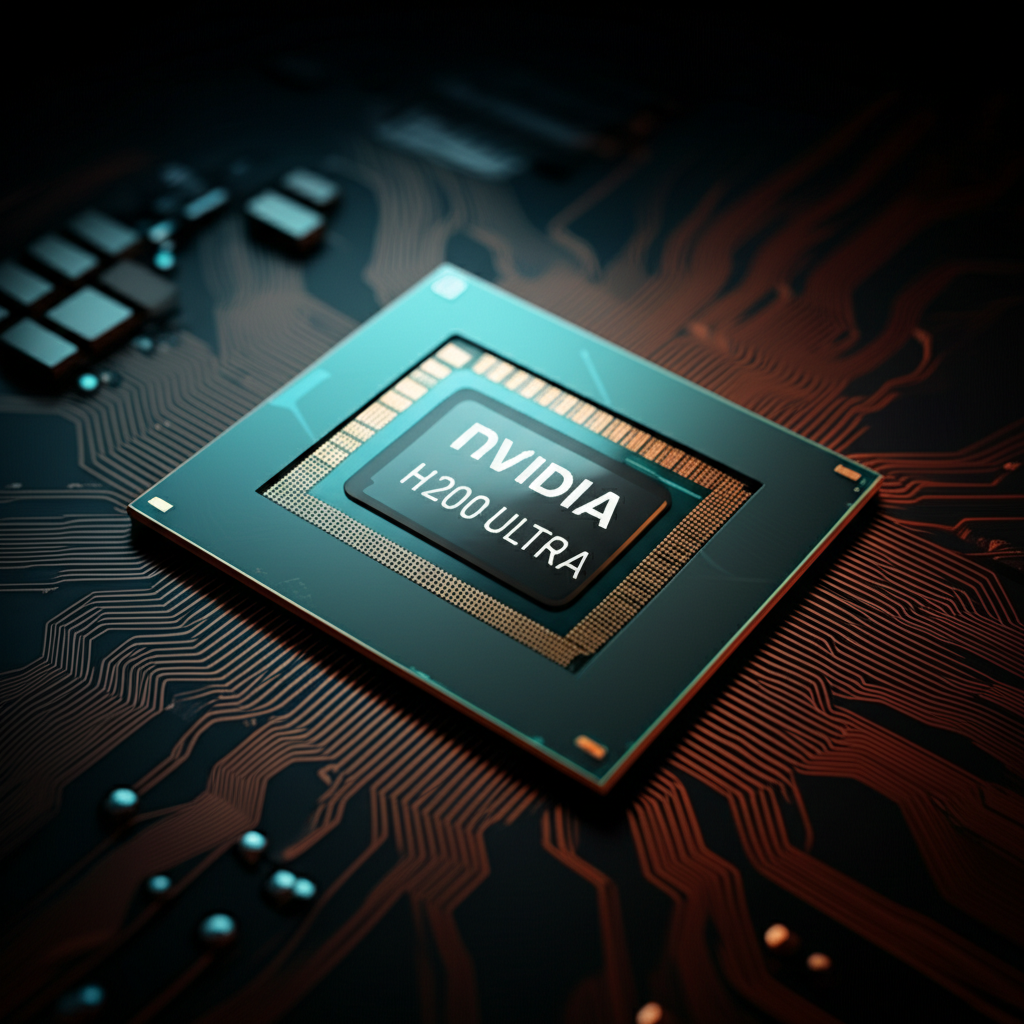
LAS VEGAS, January 24, 2026 - NVIDIA has once again pushed the boundaries of artificial intelligence hardware with the unveiling of its latest innovation, the H200 Ultra AI chip, at CES 2026. Announced during the company’s keynote address, the H200 Ultra is positioned as a game-changer for AI workloads, particularly in the realm of large language models (LLMs) and generative AI applications. With a promised performance boost of up to three times that of its predecessor, the H100, NVIDIA aims to solidify its dominance in the AI hardware market.
nnA Leap Forward in AI Performance
nThe H200 Ultra builds on the success of NVIDIA’s Hopper architecture, first introduced with the H100 in 2022. According to NVIDIA CEO Jensen Huang, the new chip leverages cutting-edge 3nm process technology and introduces several architectural enhancements tailored for the compute-intensive demands of modern AI models. “The H200 Ultra is engineered to accelerate the future of AI, from trillion-parameter models to real-time generative applications,” Huang stated during the CES keynote.
nKey specifications of the H200 Ultra include a staggering 4.5 terabytes per second of memory bandwidth and support for up to 144GB of HBM3e memory. NVIDIA claims these advancements enable the chip to handle complex LLMs with unprecedented efficiency. Early benchmarks shared during the presentation suggest that the H200 Ultra can train models like GPT-4-scale architectures up to three times faster than the H100, while inference speeds for real-time applications are improved by nearly 2.5x.
nnTargeting the AI Boom
nThe timing of the H200 Ultra’s release aligns with the explosive growth of AI adoption across industries. According to a 2025 report by McKinsey, global spending on AI infrastructure is expected to surpass $200 billion by 2027, with hardware playing a critical role in scaling AI capabilities. NVIDIA, which already commands over 80% of the AI GPU market as per IDC data from 2025, is clearly positioning the H200 Ultra to capture an even larger share of this burgeoning sector.
nThe chip is designed to address the specific needs of data centers and cloud providers powering AI services. With energy efficiency improvements of up to 25% compared to the H100, the H200 Ultra also responds to growing concerns about the environmental impact of AI training. NVIDIA highlighted that the chip’s power optimizations could reduce data center energy consumption significantly, a critical factor as sustainability becomes a priority for tech giants.
nnImpact on Large Language Models and Beyond
nLarge language models, which underpin technologies like chatbots, automated content generation, and natural language processing tools, stand to benefit immensely from the H200 Ultra’s capabilities. Training LLMs with hundreds of billions of parameters often requires weeks or even months of computation on existing hardware. NVIDIA’s new chip promises to slash these timelines, potentially accelerating the pace of AI research and deployment.
nBeyond LLMs, the H200 Ultra is optimized for a range of AI workloads, including computer vision, autonomous systems, and scientific computing. NVIDIA showcased several use cases during CES 2026, including a live demo of real-time 3D rendering powered by the chip, which could revolutionize industries like gaming and virtual reality.
nnKey Features of the H200 Ultra
n- n
- Performance: Up to 3x training speed for LLMs compared to H100. n
- Memory: Supports 144GB of HBM3e with 4.5 TB/s bandwidth. n
- Efficiency: 25% more energy-efficient than previous generation. n
- Compatibility: Seamless integration with NVIDIA’s CUDA and TensorRT frameworks. n
Industry Reactions and Competitive Landscape
nIndustry analysts at CES 2026 expressed optimism about the H200 Ultra’s potential to drive AI innovation. “NVIDIA continues to set the pace for AI hardware,” said Sarah Bennett, a senior analyst at TechInsights. “The 3x performance claim, if validated, could force competitors like AMD and Intel to accelerate their roadmaps.”
nIndeed, NVIDIA faces increasing competition in the AI chip market. AMD’s Instinct MI300 series, launched in late 2024, has gained traction among cloud providers, while Intel’s Gaudi 3 chips are expected to roll out later in 2026. However, NVIDIA’s robust software ecosystem, including tools like CUDA and optimized libraries for AI developers, remains a significant differentiator.
nnAvailability and Pricing
nNVIDIA announced that the H200 Ultra will be available to enterprise customers and cloud providers starting in Q2 2026, with broader availability expected by the end of the year. While specific pricing details were not disclosed during the CES keynote, industry insiders estimate that the chip could carry a premium over the H100, which launched at approximately $30,000 per unit in 2022. NVIDIA emphasized that volume discounts and partnership programs will be offered to major clients.
nThe company also revealed plans to integrate the H200 Ultra into its DGX systems and cloud offerings, ensuring that organizations of all sizes can access the technology through scalable solutions.
nnLooking Ahead: The Future of AI Hardware
nThe unveiling of the H200 Ultra at CES 2026 underscores NVIDIA’s commitment to leading the AI revolution. As AI models grow in complexity and scale, the demand for specialized hardware capable of meeting these challenges will only intensify. With the H200 Ultra, NVIDIA is not just responding to current needs but also anticipating the requirements of next-generation AI systems.
nFor developers, researchers, and businesses, the arrival of the H200 Ultra could mark a turning point, enabling faster innovation and more powerful AI applications. As Huang concluded in his keynote, “We’re not just building chips; we’re building the foundation for the future of intelligence.”
nnStay tuned to AiSourceNews.com for updates on the H200 Ultra’s rollout, performance benchmarks, and real-world impact as NVIDIA’s latest innovation begins to shape the AI landscape in 2026 and beyond.