
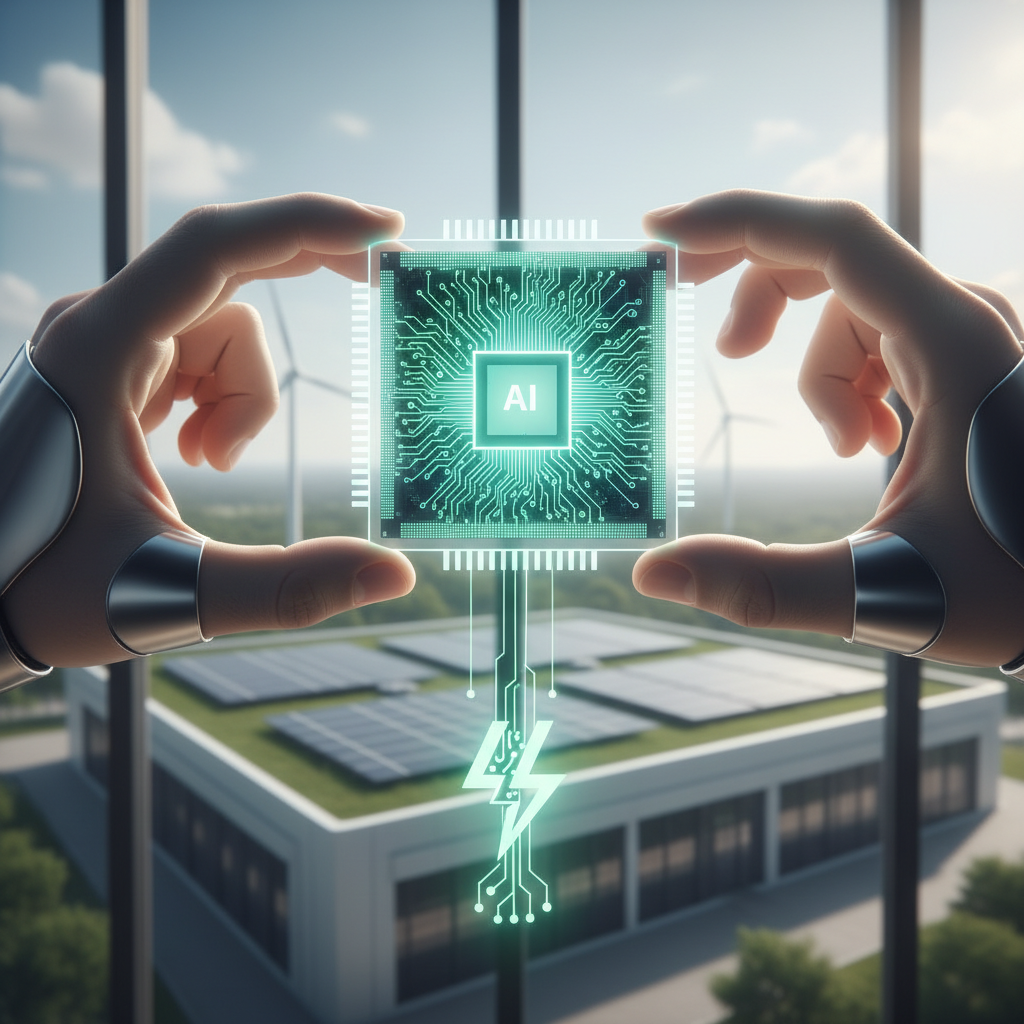
In a groundbreaking development for the artificial intelligence (AI) industry, researchers at the Global AI Innovation Lab unveiled a new energy-efficient AI chip design on March 13, 2026, that could significantly reduce the environmental impact of machine learning (ML) workloads. As AI models grow in complexity and scale, the energy consumption associated with training and deploying these systems has become a pressing concern. This latest innovation, dubbed 'EcoNeura,' promises to address these challenges by optimizing hardware for sustainable AI computation without compromising performance.
The Energy Crisis in AI Development
The rapid advancement of AI technologies, particularly large language models (LLMs) and deep neural networks, has led to an unprecedented demand for computational power. Training a single state-of-the-art LLM can consume as much energy as a small town over several days, contributing to carbon emissions and straining global energy resources. Data centers, which power much of the world's AI infrastructure, are under increasing scrutiny for their environmental footprint.
Enter EcoNeura, a specialized AI chip designed from the ground up to minimize energy consumption while maintaining the high throughput required for modern ML tasks. Unlike traditional GPUs, which prioritize raw performance over efficiency, EcoNeura leverages a novel architecture that dynamically adjusts power usage based on workload demands. This adaptive approach ensures that energy is not wasted during idle periods or low-intensity computations.
How EcoNeura Redefines AI Hardware
The EcoNeura chip incorporates several cutting-edge technologies that set it apart from existing AI hardware solutions:
- Dynamic Voltage Scaling: The chip automatically adjusts voltage levels in real-time, reducing power draw during less intensive tasks without sacrificing speed.
- Neuromorphic-Inspired Design: Drawing inspiration from the human brain, EcoNeura uses sparse activation patterns to process data, mimicking biological neural networks for greater efficiency.
- On-Chip Memory Optimization: By integrating high-speed memory directly onto the chip, EcoNeura minimizes data transfer delays and reduces energy overhead associated with external memory access.
- Thermal Management: Advanced cooling techniques ensure the chip operates at optimal temperatures, further conserving energy by preventing unnecessary power spikes.
Early benchmarks suggest that EcoNeura can achieve up to a 60% reduction in energy consumption compared to leading GPU-based systems when running complex ML models. This translates to significant cost savings for organizations operating large-scale AI systems and a smaller carbon footprint for the industry as a whole.
Implications for the AI Industry
The introduction of EcoNeura couldn’t come at a more critical time. As governments and organizations worldwide push for greener technologies, the AI sector faces pressure to align with global sustainability goals. By reducing the energy demands of AI workloads, EcoNeura paves the way for more accessible and environmentally responsible innovation.
For small and medium-sized enterprises (SMEs), this technology could democratize access to high-performance AI. The lower operational costs associated with energy-efficient hardware mean that businesses with limited budgets can deploy sophisticated ML models without breaking the bank. This could spur a wave of innovation in sectors like healthcare, education, and finance, where AI adoption has sometimes been hindered by infrastructure costs.
Moreover, the EcoNeura chip has the potential to reshape the design of future data centers. With energy efficiency at the forefront, cloud providers could reduce their reliance on fossil fuel-powered grids, aligning with renewable energy initiatives. This shift could position AI as a leader in sustainable technology rather than a contributor to environmental challenges.
Challenges and Future Outlook
While the unveiling of EcoNeura marks a significant milestone, it is not without challenges. Mass production of the chip is still in the early stages, and scaling the technology to meet global demand will require substantial investment and collaboration across the semiconductor industry. Additionally, integrating EcoNeura into existing AI frameworks may necessitate updates to software and model architectures to fully capitalize on its energy-saving features.
Nevertheless, the research team behind EcoNeura is optimistic about its future. They are already working on next-generation designs that aim to further reduce energy consumption while boosting computational power. Partnerships with major tech companies are also in the pipeline, which could accelerate the adoption of this technology in real-world applications.
Looking ahead, the success of EcoNeura could inspire a broader movement within the AI community to prioritize sustainability. As machine learning continues to underpin transformative technologies—from autonomous vehicles to personalized medicine—the need for energy-efficient solutions will only grow. Innovations like EcoNeura demonstrate that performance and environmental responsibility are not mutually exclusive but can, in fact, go hand in hand.
In conclusion, the launch of the EcoNeura AI chip on March 13, 2026, represents a pivotal moment for the industry. By tackling the energy crisis head-on, this technology offers a glimpse into a future where AI can thrive sustainably. As we await further developments and real-world implementations, one thing is clear: the path to greener machine learning has just begun, and EcoNeura is leading the way.